
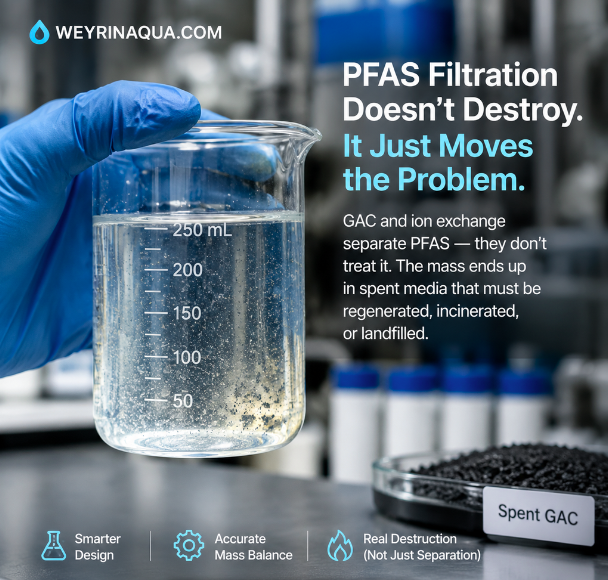
Moving PFAS from water into a solid is a separation, not a treatment. This article walks through the chemistry, the treatment train and the mass-balance arithmetic that decide whether a PFAS project actually closes the loop.
- PFAS persistence comes from the carbon–fluorine bond (about 485 kJ/mol), the strongest single bond in organic chemistry.
- Chain length, headgroup and precursor content determine which technology works. A design basis built on PFOA and PFOS alone will miss short-chain breakthrough.
- GAC, ion exchange, RO and foam fractionation concentrate PFAS. Only high-energy processes destroy them.
- Targeted LC-MS/MS sees a fraction of the fluorine in a real stream. Without total fluorine or TOP assay data, your mass balance is incomplete.
1. What PFAS are, and why they refuse to degrade
Per- and polyfluoroalkyl substances (PFAS) are a family of thousands of synthetic compounds whose defining feature is a carbon chain in which hydrogen atoms are partly or fully replaced by fluorine. They have been used for decades in firefighting foams (AFFF), non-stick coatings, textiles, semiconductor manufacturing, metal plating and many consumer products.
Two properties make them an engineering problem:
- Chemical stability. The C–F bond resists hydrolysis, oxidation and biological attack. Conventional oxidants used in water treatment do not break it.
- Amphiphilic behavior. A hydrophobic fluorinated tail and a hydrophilic headgroup (carboxylate in PFCAs such as PFOA, sulfonate in PFSAs such as PFOS) make PFAS surface-active. They partition to interfaces, adsorb to media and accumulate in biofilms and foams.
The result: PFAS pass through conventional coagulation, sedimentation, filtration and biological treatment largely unchanged, and are detected in drinking water at the nanogram-per-liter (parts-per-trillion) level.
2. Chain length decides the treatment train
The single most useful design variable is the number of perfluorinated carbons. Sorption affinity falls as the chain gets shorter. Published GAC studies report that the Langmuir adsorption coefficient decreases by roughly 0.5 to 0.6 log units for each CF2 group removed from the molecule. In practice:
- Long-chain compounds (PFOA, PFOS, PFHxS): adsorb strongly to GAC and anion exchange resin, and are partly rejected by membranes.
- Short-chain compounds (PFBA, PFBS, PFHxA): break through GAC much earlier. Anion exchange resins generally show better capacity for short-chain and carboxylate PFAS than GAC.
- Ultra-short-chain compounds (TFA, PFPrA): behave much like salt ions. GAC and conventional ion exchange are largely ineffective, and reverse osmosis is the main separation route reported to work.
An EBCT and bed life calculated for PFOA is therefore not a valid design for PFBS. Always set the design basis on the shortest-chain compound you must control, not the most abundant one.
3. Separation technologies compared
| Technology | Strengths | Limitations | Residual to manage |
|---|---|---|---|
| GAC | Mature, simple, strong for long-chain PFAS | Early short-chain breakthrough; competition from background organic matter | Spent carbon: reactivation, incineration or landfill |
| Anion exchange (AER) | Higher capacity and faster kinetics; better for short-chain and carboxylates | Sensitive to competing anions (sulfate, nitrate); resin cost | Single-use resin for destruction, or regenerant brine needing further treatment |
| RO / NF | Broad rejection, including shorter chains | Energy use, recovery limits, scaling and fouling | PFAS-rich concentrate (reject stream) |
| Foam fractionation | No consumable media; works on surface-active PFAS, suited to high-concentration streams such as AFFF-impacted groundwater or leachate | Removal varies widely by chain length (reported 60% to over 99%); weak for short-chain | Small-volume, highly concentrated foamate |
Every row ends in a residual. That is the point of this article: the separation step is only half the project.
4. Worked example: what a GAC bed actually holds
The numbers below are illustrative, using a 50,000 bed-volume (BV) bed life as in common cost-model assumptions. Real bed life depends on the shortest-chain target compound and on background organic carbon, so run pilot or rapid small-scale column tests before using it for design.
| Parameter | Value |
|---|---|
| Design flow | 2 MGD ≈ 7,571 m³/d |
| Empty bed contact time (EBCT) | 15 min |
| Total bed volume | ≈ 78.9 m³ |
| GAC mass (bulk density 450 kg/m³) | ≈ 35.5 t |
| Water treated at 50,000 BV | ≈ 3.94 million m³ (≈ 521 days, 1.4 years) |
| Influent total PFAS (assumed) | 500 ng/L |
| PFAS mass load | ≈ 3.8 g/d ≈ 1.4 kg/yr |
| PFAS captured per bed life | ≈ 2.0 kg |
| Average loading on spent media | ≈ 56 mg PFAS per kg GAC |
What this tells an engineer: about 2 kg of PFAS ends up dispersed in roughly 35 tonnes of carbon. The hazardous mass is tiny, but the waste stream is large. High-temperature reactivation or incineration must actually mineralize the fluorine, and landfilling only relocates it. Spent-media management is a regulatory and cost question that belongs in the design basis from day one, not after the first changeout.
5. Destruction technologies: where the C–F bond finally breaks
Destruction processes are usually applied to concentrates (foamate, RO reject, regenerant, spent-media extracts) because treating a large dilute stream directly is energy-prohibitive.
- Supercritical water oxidation (SCWO). Above 374 °C and 22.1 MPa, water becomes a solvent for organics and oxidation is rapid. Commercial-scale units are operating, with reported PFAS destruction above 99% for tested compounds. Engineering challenges include corrosion and salt precipitation, which demand specialized materials.
- Hydrothermal alkaline treatment (HALT). Subcritical water (below 374 °C, around 25 MPa) with added caustic. Reported reductions exceed 99%, and the process is available commercially. It consumes caustic and produces a high-TDS effluent.
- Electrochemical oxidation (EOx). Reported to have lower energy demand than SCWO and HALT, and well suited to modular, on-site treatment of concentrates. Anode durability, by-product formation (for example chlorate or perchlorate in chloride-rich matrices) and matrix effects need pilot verification.
- Plasma and photocatalytic methods. Strong degradation of PFOA and PFOS in laboratory work, but still at bench scale.
Whichever you choose, specify defluorination (fluoride release and total fluorine balance) as the performance metric, not just disappearance of parent compounds. A compound can vanish from the LC-MS/MS list by converting into one that is not on it.
6. The mass-balance trap
Targeted LC-MS/MS typically quantifies a few dozen PFAS. Real streams, especially those with AFFF, industrial or landfill influence, contain many more, including polyfluorinated precursors that transform into stable PFAAs during treatment or after discharge.
- TOP assay (total oxidizable precursor) oxidizes precursors to measurable PFAAs and reveals hidden mass. It can still underestimate ultra-short-chain and non-ionizable PFAS.
- Combustion ion chromatography (CIC) measures adsorbable or extractable organic fluorine and is commonly used for fluorine mass balances.
- Biological systems add another layer. A 2026 review in npj Clean Water argues that apparent removal in engineered biofilms should not be equated with true elimination: PFAS can be retained reversibly, transformed from precursors, or remobilized later. The authors propose separating reversible retention, transformation, remobilization and verified loss in the mass balance.
Practical rule: if influent minus effluent does not equal what you can account for in media, concentrate and destruction products, the gap is a finding, not a measurement error.
7. Regulatory drivers (verify current status for your jurisdiction)
- United States: in April 2024 EPA finalized enforceable drinking-water limits, including 4 ng/L (ppt) each for PFOA and PFOS. Implementation timelines and the status of the other regulated PFAS have been under review, so check the current federal rule before fixing a compliance date.
- European Union: the recast Drinking Water Directive sets 0.1 µg/L for the sum of 20 individual PFAS and 0.5 µg/L for total PFAS, applicable from 2026.
- Technology policy: in October 2026 the US EPA launched its PFAS TECH strategy to support research, real-world demonstrations and technical assistance for PFAS treatment and destruction.
8. A design checklist for engineers
- Characterize the stream: targeted PFAS list, TOP assay, total organic fluorine, background TOC, competing anions.
- Set the design basis on the shortest-chain compound you must control.
- Pilot columns (RSSCT or on-site) to establish real bed life, not the cost-model default.
- Choose the residual pathway first: reactivation, incineration, regeneration with onward destruction, or on-site destruction.
- Define success by total fluorine balance and defluorination, not by parent-compound removal.
- Plan monitoring for breakthrough of short-chain species, which appears well before PFOA or PFOS.
Conclusion
PFAS treatment is two problems: separating a persistent contaminant at ng/L concentrations, and then dealing with the concentrated residual. Plants that budget only for the first step carry the second as unpriced liability. Treat chain length as the design variable, total fluorine as the measure of truth, and destruction as part of the flowsheet.
Selected sources
- US EPA, Technologies and Costs for Removing PFAS from Drinking Water (March 2024).
- Comparative investigation of PFAS adsorption onto activated carbon and anion exchange resins during long-term operation of a pilot plant, PMC11330578.
- Technology status to treat PFAS-contaminated water and limiting factors for full-scale application, npj Clean Water (2025).
- Zafar R. et al., Engineered biofilms as compartments regulating PFAS fate in water and wastewater treatment, npj Clean Water (2026).
- Supercritical Water Oxidation as an Innovative Technology for PFAS Destruction, PMC10428202.
- SERDP-ESTCP, Hydrothermal Alkaline Treatment for a Closed-loop, On-site PFAS Treatment Solution.
- Spent Media Management Pathways for PFAS Treatment Applications, PMC12260480.
- Minnesota Pollution Control Agency, Evaluation of Current Alternatives and Estimated Cost Curves for PFAS Removal and Destruction.
